Rising Interest Rates Threaten Global Expansion
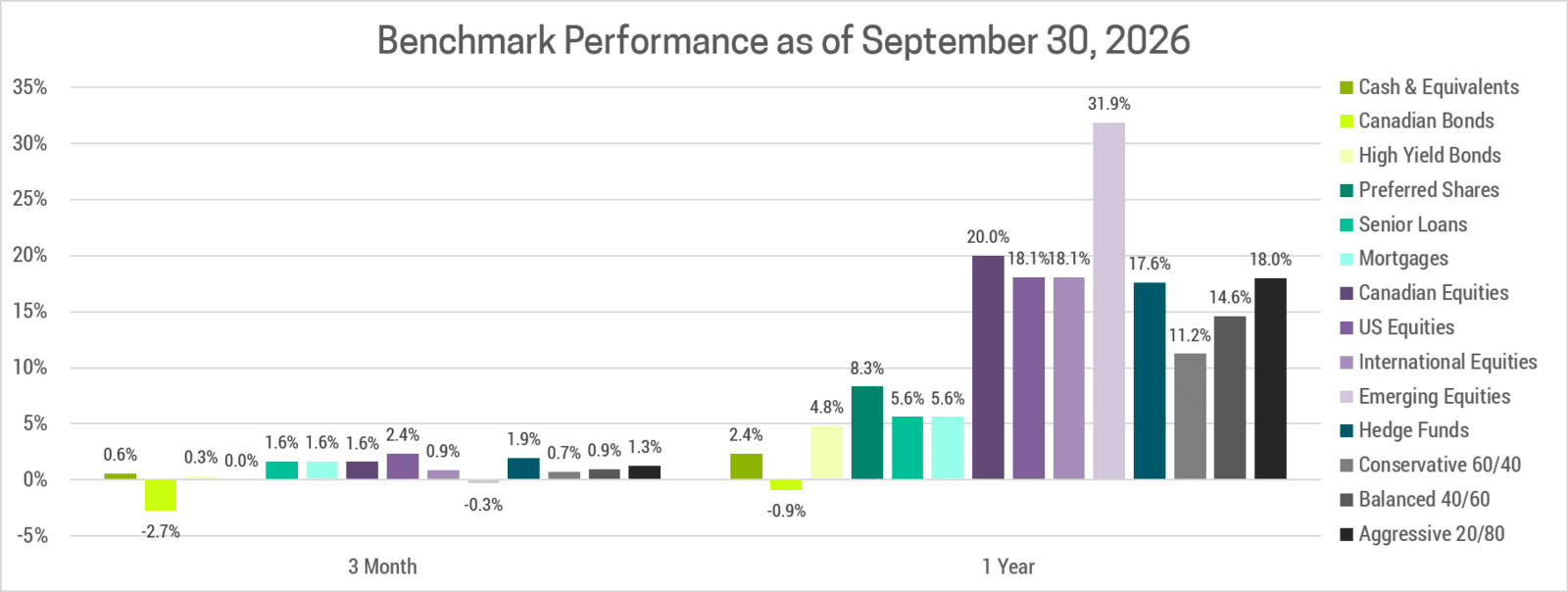
Markets were choppy in Q3 driven by a re-escalation of the Iran war which pushed up energy prices and inflation. This forced central banks to hike rates and bond yields surged to new multi-decade highs. We have been expecting this, which is why we’ve remained underweight bonds and have prioritized short-term and floating rate debt. This helped client portfolios outperform the benchmark in Q3 while exhibiting considerably less volatility.
The economy has proved far more resilient than the consensus expected, but inflation pressures are building, government deficits are rising and bond investors are demanding compensation for these risks. Strong corporate earnings have allowed markets to shrug off the negative impact of rising bond yields so far. The question is, how high can yields go before they derail the economy.
WHY ARE YIELDS RISING?
The short answer is that we've had too much stimulus for too long. Central banks cut rates too aggressively in 2024-2025 and governments have continued running big deficits, even though the economy kept growing and inflation stayed above target. That extra fuel is showing up now as stronger growth and firmer prices.
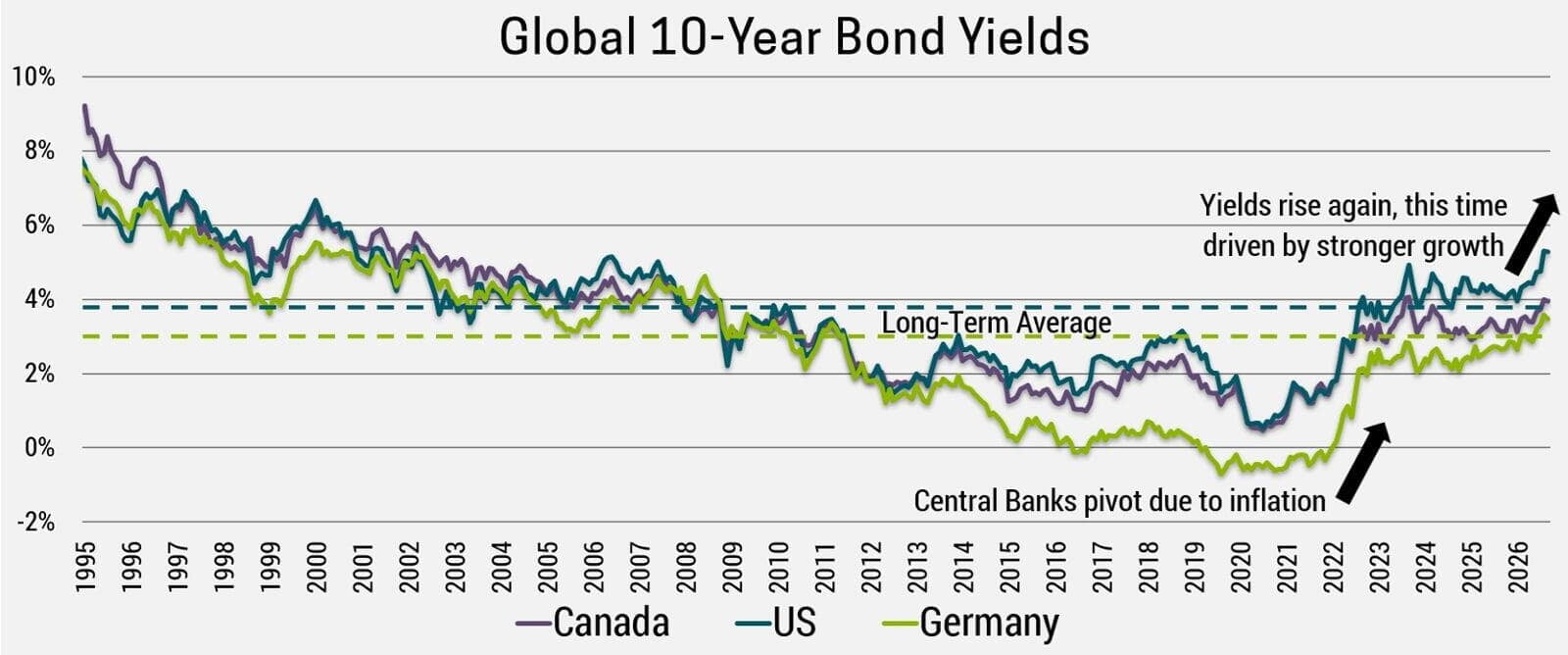
Most of the recent rise in yields has come from investors expecting stronger economic growth, not from panic about inflation. Investors believe the recent uptick in inflation is temporary, or that a modest increase in interest rates will be enough to send inflation back to 2%. In fact, the consensus expectation is for U.S. inflation to average 2.4%/yr over the next decade. You can see this by looking at the difference between the U.S. 10-year treasury yield (5.3%) vs the U.S. 10-year treasury inflation-protected yield (2.9%).
We believe inflation will be persistently higher going forward and that it will require far more rate hikes to rein in than the consensus currently believes. We talked about this last quarter so I won’t rehash it here, but the main theme is that the 2000s and 2010s were unusually low-inflation decades, and markets still treat that as the default. Once investors start to price in higher long-term inflation, yields would move higher, at which point parts of the economy could start to break.
RETURN ON CAPITAL VS. COST OF CAPITAL
Imagine you borrow money at 4% to buy a rental property that earns 6%. You're making money, so you'll probably buy another one. Now imagine your borrowing cost creeps up to 5%. The deal barely works and probably isn’t compensating you for the risk. At 6%, there’s no upside, so you stop buying and start selling what you have.
The whole global economy works the same way. The "return on capital" is how fast the economy is growing in dollar terms (economists call this nominal GDP). The "cost of capital" is what it costs to borrow, meaning interest rates and bond yields. When growth is well above borrowing costs, money is cheap relative to what it can earn. Businesses invest, people buy homes, and stock prices rise. When borrowing costs catch up to growth, the party ends.
Right now, return on capital is high. Economic growth in the U.S., Japan and the euro area is strong, and AI spending is a big part of the story. That’s why even with the surge in yields we’d still call conditions mildly supportive, but the cushion is shrinking. Historically, once the gap between growth and borrowing costs closes, the weakest borrowers start to crack, and the damage spreads from there.
THE RISK: A GROWTH SHOCK
A lot of today's strong growth is a product of earlier stimulus and the AI building boom, neither of which will last forever. Data centers are enormously expensive to build, and most are financed with borrowed money. As yields rise, so does the cost of funding them. Companies need AI services to earn a return that clears the new, higher hurdle, and some projects won't. In the corporate bond market, yields on the riskiest borrowers (CCC-rated) have already surged. Investors are starting to ask for more discipline from big tech spenders, and lenders could pull back or demand higher interest rates.
For about half of the stock market's sectors, corporate bond yields are now higher than expected sales growth. That means new projects are getting harder to justify. The overall market still looks fine on this measure, but only because expectations for tech sales are very high, and those expectations depend on the AI story holding up. If companies cool on AI spending because borrowing is getting pricier, economic growth could slow meaningfully.
RISING YIELDS BREAK THE WEAK LINKS
The danger isn't the average borrower, it’s those at the margin. A small rise in borrowing costs for households or governments that carry too much debt becomes a big problem. We’ll call these the "weak links". When one snaps, the pain spreads to trading partners, banks and markets. There are three weak links we are watching in Europe:
- France: Its economy isn't growing fast enough to outrun higher yields, and the government already carries too much debt to spend its way to higher growth without spooking bond investors. The gap between French and German bond yields has widened sharply, which tells us investors are getting nervous about holding French debt.
- Italy: Faces a similar squeeze, albeit the contagion risk to the global economy is less since their economy is 24% smaller than France. They carry more debt relative to GDP, but their trajectory is less concerning due to stronger economic growth and smaller ongoing deficits.
- The U.K.: A weak economy with limited fiscal flexibility, as seen when Liz Truss tried to cut taxes in September 2022, triggering financial turmoil that ultimately ended in her resignation after 49 days in office. Trouble here is likely to spill into neighbouring economies.
The U.S. and the euro area as a whole are in better shape, with solid household finances, strong incomes and government support. That's why a global recession isn't our base case. But a weak link snapping is how a growth scare starts.
CANADA: THE CANARY IN THE COAL MINE
Unfortunately, Canada is also a weak link. In our Q2 2022 newsletter, we warned of a housing bubble, and in Q3 2023, we examined Canada’s housing affordability crisis in depth. Affordability depends not only on home prices but also on borrowing costs. After decades of rising prices, the sudden surge in interest rates turned a long-standing imbalance into a crisis.
When interest rates peaked in 2023, major banks reported that roughly 20% of outstanding mortgages were "negative amortization," meaning mortgage payments didn't even cover the interest. While this technically constitutes defaulting on the debt, the banks had no incentive to foreclose on so many borrowers. They would have struggled to sell the properties as there simply weren’t enough qualified buyers due to high prices, interest rates and strict stress tests.
After all, demand isn't how many people want a home, it's how many can afford one.
Instead, they allowed struggling borrowers to add the shortfall to the loan, in the hopes interest rates would fall. When inflation finally fell below 3%, the Bank of Canada was happy to provide much needed rate cuts. With interest rates rising anew, it’s worth revisiting Canadian housing as it’s another potential weak link in the global financial system.
Much of our analysis from Q3 2023 is still relevant, but let’s focus on what’s changed. Home prices have fallen, but buyers have not surfaced due to a relatively soft economy, the trade war and dramatically lower immigration. Sellers seem unwilling to cut asking prices further, so population-adjusted sales have hit multi-decade lows.
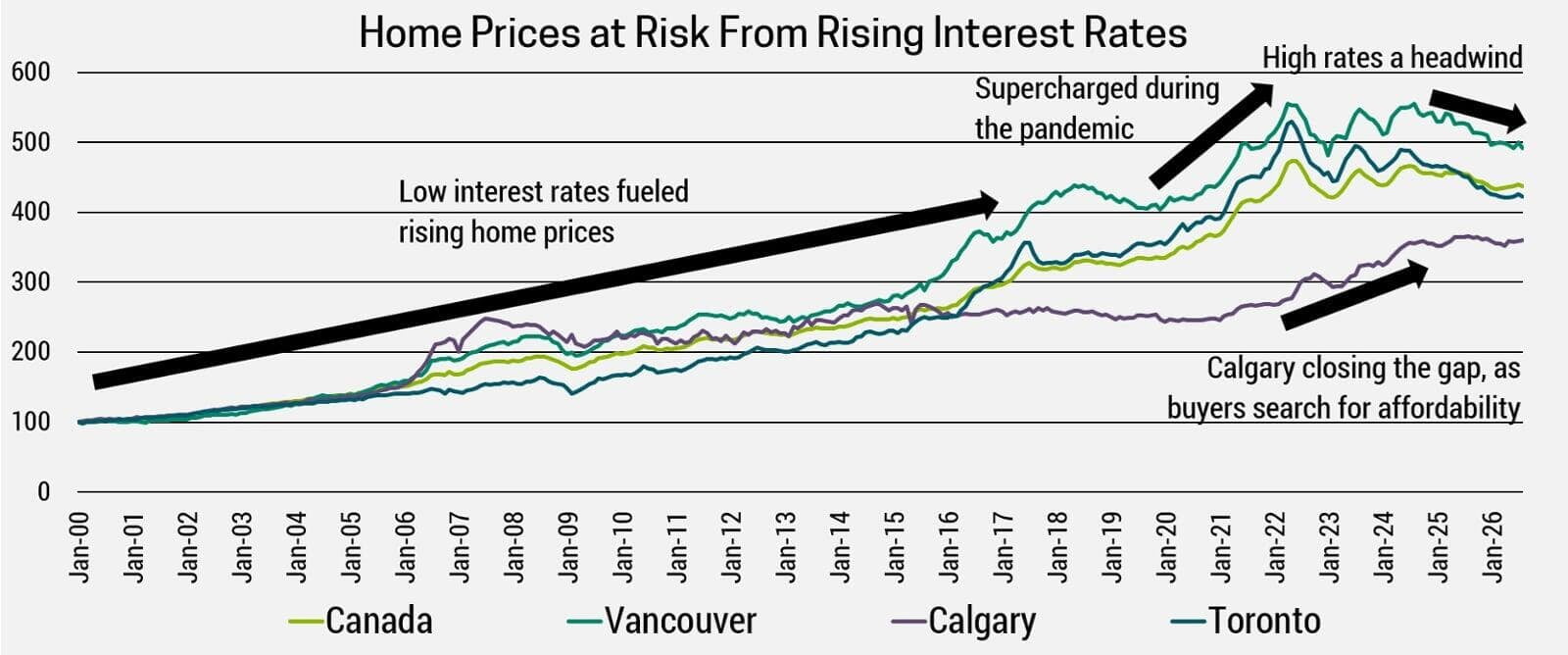
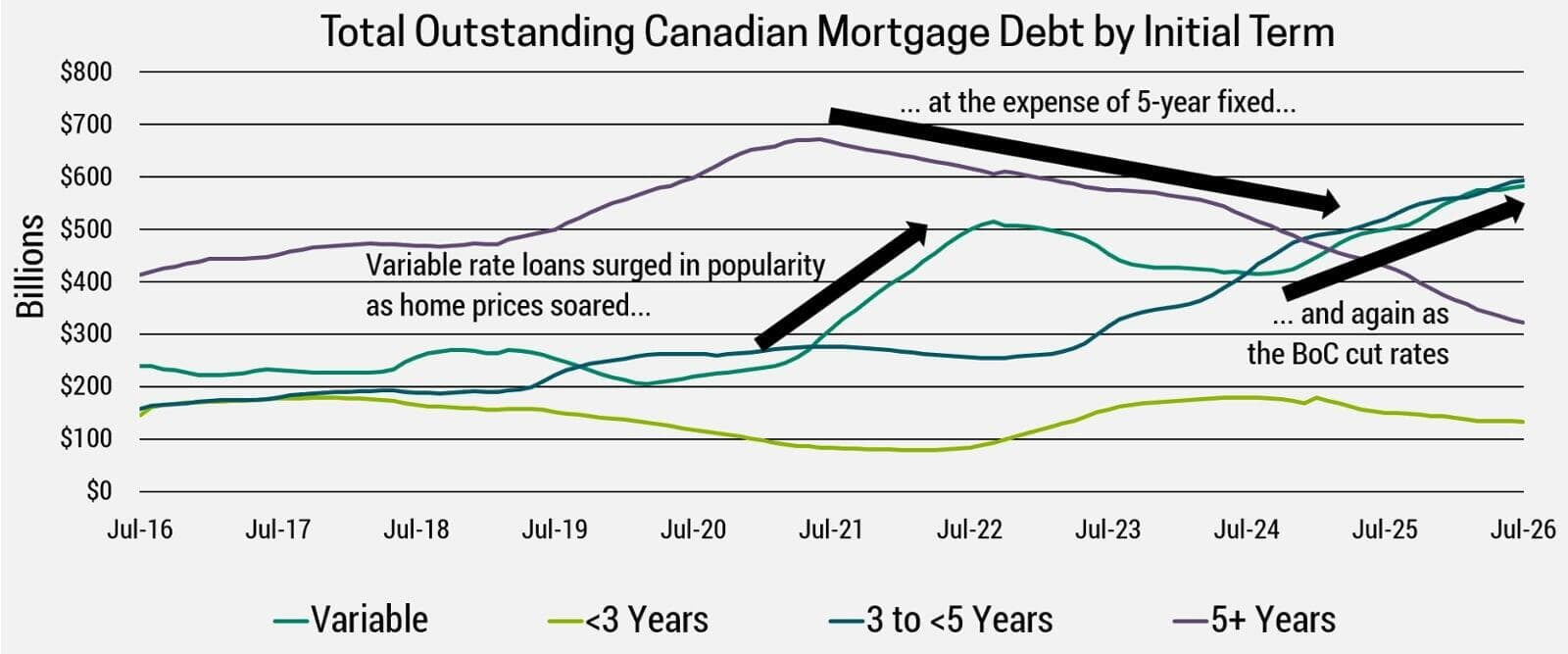
Canadian households remain among the most indebted in the world. Many of the borrowers who were most underwater moved to variable-rate mortgages. That has protected them from the recent rise in long-term bond yields, but it ties the Bank of Canada's hands, because raising its policy rate dramatically could trigger a housing crisis. Meanwhile, Canadian long-term yields are being dragged up by global yields, which means fixed rate mortgages are already getting more expensive.
What this means for you:
- Buyers: Stay patient. Prices are still high relative to incomes, and you don't need to rush the biggest financial decision of your life.
- Homeowners: If you're renewing soon, consider going variable instead of fixed. We expect rates to rise, but not as much as the markets already priced into 5-year fixed rates. Any significant interest rate increase is likely to prove temporary as it will trigger another affordability crisis and subsequent rate cuts, similar to 2023-2024. Save extra while rates are low, and if payments are already tight, consider paying down debt or downsizing.
- Investors with rentals: Calculate your profit after all expenses and compare it to what you could earn in a diversified portfolio. We’re projecting 6-7% long-term annualized returns in the market, so if the rental isn’t generating a comparable profit, you're better off selling it and investing the proceeds.
SO WHEN DO RISING YIELDS DERAIL THE MARKET?
We can't give you a magic number. The tipping point moves with the economic cycle, with how much support governments are giving, and with how much debt is sitting in the most rate-sensitive corners of the economy. What we can tell you is what we’re watching:
- Speed and reason: A steady rise driven by better growth is manageable. A sharp, open-ended spike driven by inflation fears, or by a belief that central banks will have to turn restrictive, is how equity crashes happen.
- Yields vs. growth: The closer borrowing costs get to economic growth, the thinner the cushion.
- The weak links: A financial crisis in France, Italy or the UK, stress in Canadian housing, or a blowout in credit spreads would be early warnings.
- Corporate bond yields vs. sales growth: If more sectors cross over, expect companies to pull back on investing and hiring.
- AI financing: Any pullback in data center lending would be a red flag for a trade that has driven much of the market.
PORTFOLIO STRATEGY
Bonds are oversold in the short term and due for a breather, but until the bond market settles, it's hard to make a confident bet on stocks. A relief rally from falling interest rates would likely be the opportunity to get more defensive, as we believe interest rates will continue moving higher until a significant part of the economy breaks.
We're keeping our focus on shorter-duration assets like floating-rate debt, which benefit from rising rates rather than suffer from them. We also favour value stocks and markets outside expensive U.S. tech. We're staying away from the hottest, most hyped corners of the market, and expect our next move will be to go underweight equities, from our current neutral stance. The economy is still strong, and the backdrop for risk assets is still supportive for now, but the cushion is thinner than it was.